Search This Blog

Sunday, October 24, 2010

our lady of the sign

The Cathedral of Our Lady of the Sign is in the Torgov quarter of Veliky Novgorod, E. of the Volchov River.  Its date is 1688 and the frescoes were painted by local artists from Krostroma in 1702 which survive.  For the most part other frescoes we saw in churches were restorations or subject to the practise of continually overpainting, so these stood out, and also because they include secular scenes. 


Friday, October 22, 2010

klopsky trinity monastary

On our way to the town of Staraya Russa we stopped at this monastary complex which is being restored by the church.  It is alongside the Veryazha River near Lake Ilmen.  Obviously a work in progress.  The monastary was first mentioned in writings in 1412.


Model of the church


Bell tower on the right


Friday, October 15, 2010

дачи и дома [dachas and homes]

The old house of our friend in Velichy Novgorod is exactly like hundreds we saw in town and in the countryside.  There are variations, some two story varieties, but this is the most common.  Today this particular house is worth over $100k because of the land value and boom in building $1-2 million varieties like the houses next door (below).  If he ever sells, the house will be torn down for a new McMansion.


On our bus ride from St. Petersburg to Novgorod we saw the dacha communities scattered all along the way.  There were a wide range of conditions of these country properties; some looking abandoned, and many appearing to be updated or in the process.  Almost a third of Russian families own dachas, which may or may not have a house on them, but are typically a place to get away from the city and grow a garden.  Traditionally the houses were primitive but that is changing.  I got the impression the whole tradition of dachas might be shifting.  These pictures were taken out the bus window.


Tuesday, October 12, 2010

dostoevsky house in staraya russa

F. M. Dostoevsky had a summer house in the village of Staraya Russa (Old Russia) during the later years of his life, and where he wrote most of The Brothers Karazamov.  The survival of the house is a near miracle, given its wooden construction, and that Staraya Russa was just about obliterated by the Germans during their occupation and siege of Leningrad (St. Petersburg).  Our guide stated that the house was spared because of its association with Dostoevsky. 


Monday, October 11, 2010

gatchina

Gatchina, the palace of Paul I is about an hour south of St. Petersburg.  Empress Catherine II, his mother, supposedly gave the palace to Paul to keep him as far away from her throne as possible.  The ground floor of the central part of the structure has been restored.  German occupation in WWII caused considerable destruction.  It was interesting to see parts that were restored, vs. parts that were not; to see the extent of the damage.  The palace is off the beaten track because of distance from the city, so you need to take a translator for the Russian language tour guides. 


Unrestored Area


Sunday, October 10, 2010

windows in russia

Most windows I saw in older buildings in Russia were double, even in Soviet era construction.  The wide spacing between panes of glass wouldn't be as efficient as modern double pane, but given Russia's long history of keeping out the cold this way it will be a long time before the US catches up in btus saved with our modern windows.
Window in poet Anna Akmatova's museum home in St. Petersburg

Friday, October 8, 2010

dinner with the gavrilovs

One of the best meals and highlight of the Russian experience was an evening with the Gavrilovs, a family from Velichy Novgorod.  Son Borya and his mother's friend (Irenya I believe) were our translators.  Yougest son Vanya, about 4 years old, was our entertainment.  The photos were taken by Borya except for his photo and the table setting photo.


Vanya, Andrei, Myself, my bro-in-law Doug, and Borya


Vanya interprets Hall of the Mountain King from Peer Gynt. 

Wednesday, October 6, 2010

russia trip

Well, I'm back in the USA after my trip to Russia.  I shot over 600 photos, and there are way too many thoughts to even begin to convey, so here are just a few photos and comments for now.
 The large central couryard between the regional administration building and the old kremlin walls is a favorite place for skateboarding, etc.  This is one of only two remaining statues of Lenin in the city of Veliky Novgorod.
 The architectural museum is a park where examples of the old Russian houses, etc. were reconstructed and displayed.  This is the interior of a "black house", so-called because the oven/fireplace smoke discharges into the room and is then let out by a damper in the cieling, creating a layer of smoke and soot just below the cieling.  This concerves firewood.  By contrast, the "white houses" of the more well-to-do wastefully discharged the smoke up a chimney and out.
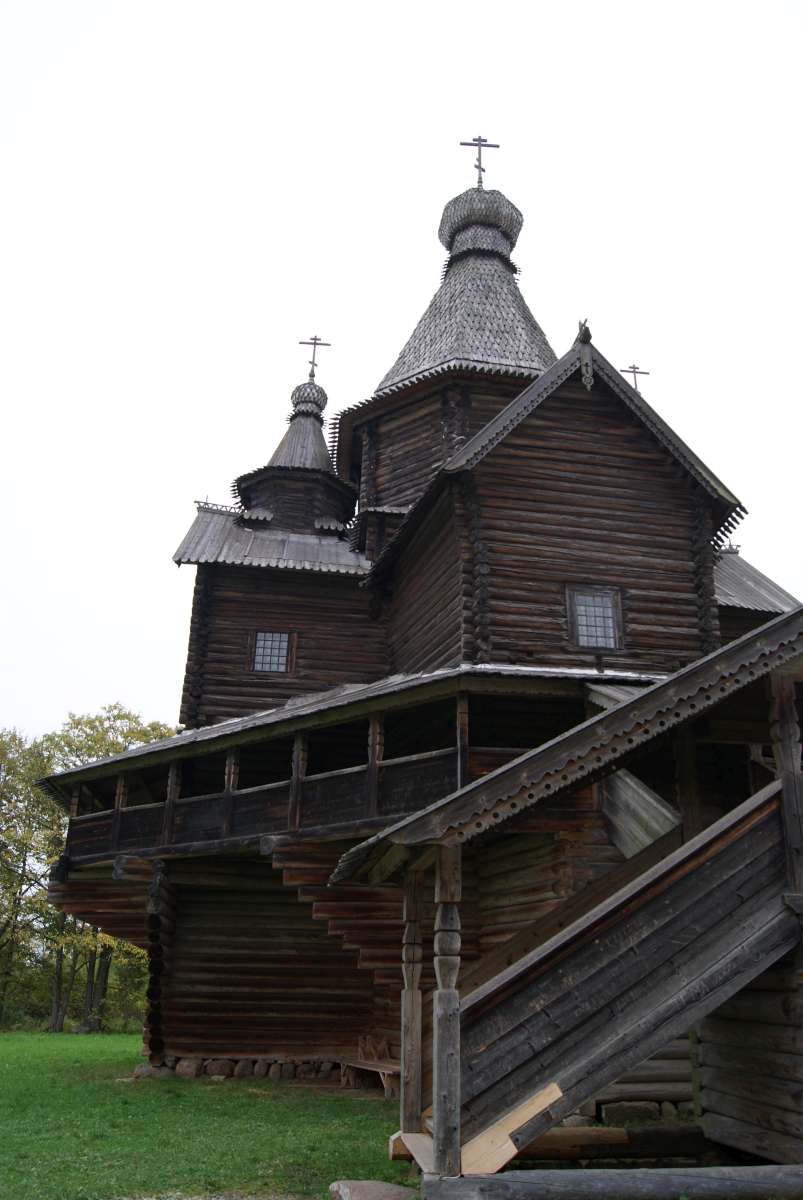
 This church, prior to being collected and reconstructed at the architectural museum, had rotted down to the level of the balcony in the photo.
 View of the walls of the kremlin at Veliky Novgorod.  The towers are 17th Century. 
 Class in the Internet High School where I gave a 40 min. talk on Historic Preservation in Mansfield.  The students in this school are specially chosen, including the best and brightest recruited from country areas who board at the school, like an English boarding school.  This school experiment is only a few years old.
Probably not too often on tour iteneraries; a Russian cemetery.

Wednesday, July 28, 2010

medina

Our little delegation just returned from Medina this afternoon.  Attendees were:
Connie Pastor, Iwana Wagner, Chuck Gleaves, Marge Cutnaw, Ellen Haring and myself from the Historic Preservation Commission, Mayor Culliver, and Jamie Thompson from Downtown Mansfield Inc.
Roger Smalley of the Community Design Committee talks to our group.


If this bandstand looks familiar, it's because Medina's is a replica of the Bellville gazebo.  Medina's central park is unclutered, which has been the result of a concerted effort to maintain a Victorian style park, with no evergreens or shrubs to block the view through it.  One stone memorial to the man who donated the land for the park, and a granite drinking fountain memorial are the only two monuments.  Other memorials and monuments in Medina have been located elsewhere over the years, but the park has been relatively un-spoiled.

Most of the credit for the successful effort in Medina stem from the CDC's efforts to give property owners a preview of what restoration will look like.  When property owners are planning restorations and new work, the CDC provides color architectural renderings of the building in question to influence the property owners choices.  This has worked and has driven many of the restorations, giving the Square an artistic, variegated color rhythm complementing the historic preservation approach. 

This building from the 1980s was designed by Mansfield architect Robert Soulen.


The old court house and its newer additions dominate the block opposite the east side of the Square.


The Public Square District includes the 8 blocks surrounding the Square, plus the Square itself.  A committee of 5 people have the design review authority for exterior changes...the same process rendered by our own Preservation Commission.  Medina's Preservation Ordinance is modeled very simiilar to Mansfield's.  One of our reasons for looking at Medina was to see how our own efforts with the Central Park Historic District here might achieve the kind of cooperation and unity of purpose that has developed in Medina.


Major highways crossing through the Square create a noisy, but busy atmosphere. 

Our meeting over lunch clearly revealed that there is a great spirit of cooperation in Medina between the Community Design Committee, Preservation Commission, Main Street, Administration, and city Department of Development.  In effect, everyone "gets it", in that they understand the economic benefits of preserving the Public Square area.  Preservation advocates have encountered the same opposition and roadblocks that we all have to deal with in these efforts, but today there is ample proof in the validity of the approach.

Attending our lunch meeting and discussion were Mayor Dennis Hanwell, City Planning Director Greg Hannan, Main Street Director Matt Wiederhold, Roger Smalley of CDC, and Economic Development Director Tom Krueger. 

Sunday, July 25, 2010

medina trip


The Preservation Commission is taking a daytrip over to Medina Public Square this Wednesday, July 28. Our purpose is to visit the Public Square Historic District and find out more about the Community Design Committee's role in establishing the district and administering design review. We're meeting over lunch with Medina city officials who are involved with the Public Square. I'd like to document the trip and provide feedback via this blog, so watch for that later in the week.